-

Rachel Kryshak
Multiple Authors
We have reached the medal round of the 2026 men’s Olympic hockey tournament, and what a tournament it has been. It has been thoroughly entertaining from start to finish in the preliminary round, with surprising talking points and expected brilliance from the best hockey players on the planet.
Simply put, the Olympics are better when NHL players are participating. There is no other tournament where the best players are available to represent their countries with so much on the line. Not every player is available for the IIHF world championships in the spring, and obviously, not every nation participated in last year’s 4 Nations Face-Off.
Throughout history, there have been many players who found an extra gear while representing their country on the biggest stage. There are players accustomed to playing major roles on their NHL teams that play lesser roles internationally, and their play drops off as a result.
Heading into the medal round, the standings look a little different than many expected. Sweden and Finland struggled at various points, Slovakia and Switzerland overperformed their expectations, and it feels like an upset or two is brewing as the tournament hits its stride.
Here are the standouts and disappointments from group play, with the qualification round up next.
The standouts
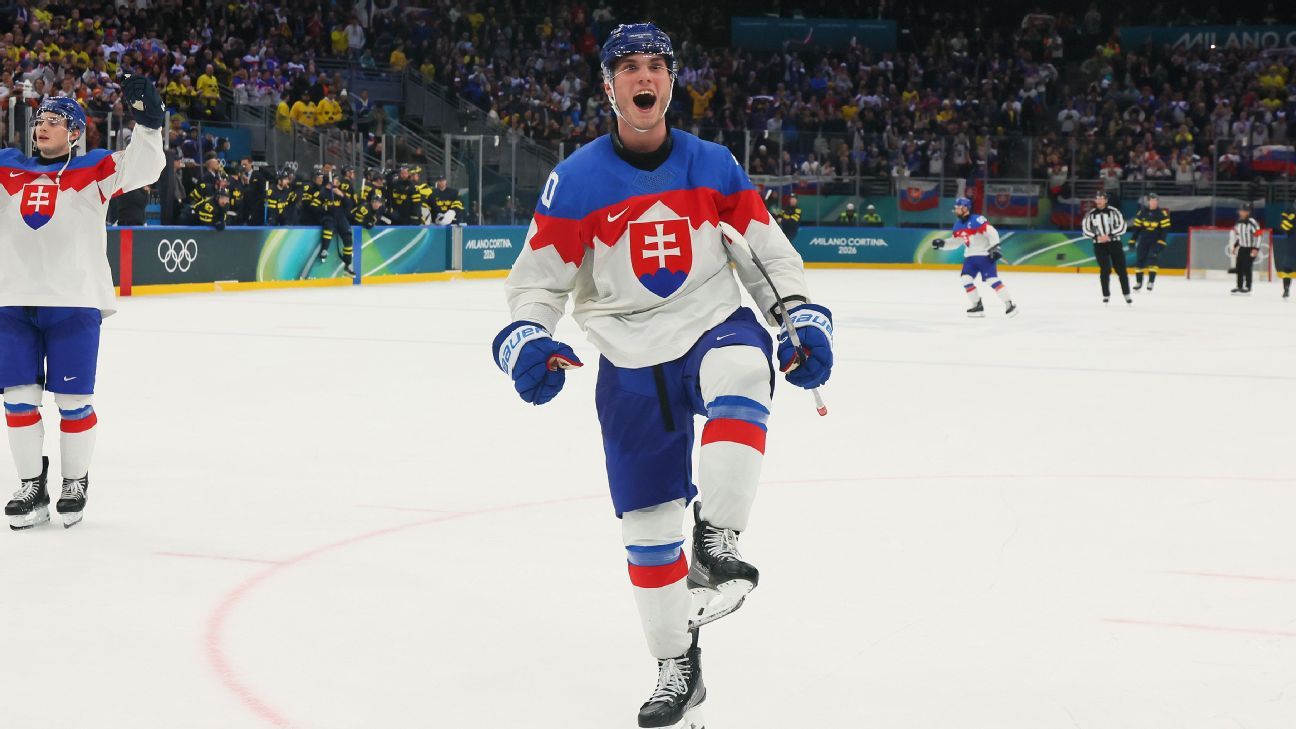
In the tournament X factors story, I noted that the next wave of Slovakian hockey was going to have to lead the charge. Slafkovsky has been one of the tournament’s best players, nothing short of brilliant for Slovakia. Tied for second in tournament scoring with six points, Slafkovsky has been the catalyst.
He has blossomed into an impactful power forward over the past 18 months, and though he has always performed well in international play, he has taken another step at the Olympics. He leads Slovakia in points, shots, slot shots and scoring chances. He has created at critical times, scoring the opener and the insurance goal against Finland, and creating the critical third goal late against Sweden. He’s not just the future of Slovakian hockey, he’s the present.
Slovakia was in the hardest group, along with Sweden and Finland, and emerged victorious, earning the No. 3 seed for the knockout stage. That was a shock. It seems that fears of the downfall of Slovakian hockey have been greatly overdramatized.
Samuel Hlavaj has been tremendous in goal for Slovakia, sporting a .934 save percentage, and he was particularly stupendous against Finland. Hlavaj’s play has led to a fortunate seeding that will see Slovakia play either Germany or France in the quarterfinal, with a great chance of earning a semifinal berth.
Slovakia has outperformed expectations through the preliminary round and has a real chance to be the Cinderella story of the Olympics. A semifinal berth in a best-on-best event would be an overwhelming success for Slovakian hockey — and something to build on with its young foundation of skilled players.
The first overall picks
Beyond Slafkovksy (2022), the first overall picks are dominating the tournament. The top five scorers in the tournament are former first overall picks. Connor McDavid (2015) has been the best player in tournament, averaging a point per period. Macklin Celebrini (2024) and Sidney Crosby (2005) are tied with Slafkovksy with six points. Auston Matthews (2016) and Nathan MacKinnon (2013) have five points through the preliminary round.
McDavid leads the tournament in scoring and scoring chance contributions. His speed has been a difference-maker, and his ability to draw defenders and make plays to his teammates has propelled Canada’s offensive explosion. The combination of MacKinnon’s and McDavid’s speed has proved to be nightmare fuel for defenders, and Celebrini’s smart play off the puck has made him the perfect complement. If those three continue to perform at their current level, stopping them will be a gargantuan, potentially impossible task.
For all the talk about Matthews’ decline over the past few months, he leads the United States in goals, points, inner slot shots and scoring chances. He’s creating off the rush and off the cycle, he’s at the net front wreaking havoc, and he has been a prominent focus of defensive matchups. Matthews had been performing better for Toronto prior to the Olympics, and his play has carried over to the tournament.
Given that the United States left high-powered scorers like Jason Robertson and Cole Caufield off the roster, his resurgence came at the most critical time. If the United States is going to run the medal round gauntlet, Matthews will need to continue to create offensively and score in critical situations.
1:16
USA men’s hockey faces challenging road ahead
Greg Wyshynski breaks down the U.S. men’s hockey team’s potential path to Olympic gold.
Leonardo Genoni turns back the clock
Many may not have been familiar with Genoni prior to the tournament, but this is not the first time he has been spectacular for Switzerland in international play. The 38-year-old has been brilliant for Switzerland and the main reason for the team’s fifth-place finish in the preliminary round. Rocking a save percentage of .949 and saving 2.5 more goals than expected through three games, Genoni has been the backbone of Switzerland’s success.
Genoni gave up three goals against Czechia and shut out France, while getting the night off against Canada. It is Genoni’s net in the medal round, and if the Swiss meet expectations and beat Italy, Genoni will likely face a heavy volume of scoring chances from Finland in the quarterfinal.
If the Swiss were to then upset Finland, a date with Canada or the United States likely awaits. Genoni would be under immense pressure to keep the Swiss within striking distance, something he is capable of doing. He has already been one of the best goaltenders — and one of the stories of the Games in what may well be his last Olympics for Switzerland.
Disappointments
Sweden: From coaching to goalies
If anyone had Sweden finishing third in the group, please send your lottery numbers over to me. With Finland lacking the injured Aleksander Barkov and Slovakia lacking depth, many expected Sweden to come away with a bye into the quarterfinals. Not only did that not happen, but Sweden is also staring down the barrel of a quarterfinal matchup with the United States if it beats Latvia, as expected.
There have been plenty of mistakes from the Tre Kroner, starting with the coaching staff.
Filip Forsberg, who ranks fourth in scoring this season among Swedish forwards, inexplicably started the tournament as the 13th forward. Through the preliminary round, Forsberg ranks first in slot shots and chance contributions per 60 minutes, and second in inner slot shots per 60 among Swedish forwards. And yet … he ranks 14th in ice time.
Sweden has struggled to create offense against inferior opponents, and Forsberg’s offensive abilities could have been helpful. If Sweden is going to play for a medal, he needs to be deployed much differently, and more often. Sweden is deep enough to run three scoring lines, and while there is a legitimate argument for Forsberg to play in the top six, anything less than a third-line role to create secondary offense would be a significant misstep on the part of the Swedish coaching staff.
The goaltending has left a lot to be desired, and it is surprising that coach Sam Hallam opted for Jacob Markstrom over Jesper Wallstedt given their respective performances this season. Filip Gustavsson has been disastrous in goal, with alarming miscues against Italy and struggles in the loss against archrival Finland. When Hallam went to Markstrom for a crucial third game, instead of his young goaltender, he paid the price. That decision was likely the difference between a quarterfinal bye and the collision course with the United States.
With two shaky goaltenders, Hallam is faced with a choice: Hope that one of them finds their game — or trust an NHL rookie who hasn’t played in more than two weeks.
Switzerland entered the tournament with an outside chance for a medal and still has a chance to win one. The team’s NHL talent, led by Fiala was a major reason for those beliefs.
Unfortunately, his tournament — and NHL season — came to a screeching halt on an awkward hit in the dying moments against Canada. Fiala was stretchered off the ice after getting tangled up with Tom Wilson and required surgery to repair his lower leg.
It’s a significant loss for Switzerland, as Fiala was playing on the top line with Timo Meier and Nico Hischier, carrying the offensive load.
Fiala’s injury brought NHL participation to the forefront, with NHL owners fearful of players participating for this very reason. While there is hope that Fiala’s injury does not cause uproar among owners, there is a very real fear that it may impact future Olympic participation beyond the collectively bargained 2030 Games.
All the best to Fiala in his recovery, while hockey fans hope this does not jeopardize NHL participation at future Olympics. That would be the most disappointing result of all.
Source link