-

Buster Olney
Multiple Authors
Spring training camps are underway, which means it is time to look at the state of baseball. As part of our 2026 MLB season preview, ESPN’s Buster Olney surveyed those around the industry to help him rank the top 10 players at every position as part of his annual positional ranking series.
Today, we rank the best of the best at second base.
The objective of this exercise is to identify the best players for the 2026 season, not who might be best in five years or over their career. We will roll out a position per day over the next two weeks. Here’s the rest of the schedule: starting pitchers (Monday), relief pitchers (Tuesday), catchers (Wednesday), first basemen (Thursday), third basemen (Feb. 23), shortstops (Feb. 24), corner outfielders (Feb. 25), center fielders (Feb. 26), designated hitters (Feb. 27).
The most coveted free agent in the fall will be Tarik Skubal, probably commanding offers that might well shatter the record for a starting pitcher — the $325 million contract signed by Yoshinobu Yamamoto in 2023. But as for impending free agent position players, Jazz Chisholm Jr. would seem to be a candidate to land the biggest deal, with some gaudy numbers on his résumé.
He was a 30-30 player for the Yankees last season, with 31 homers and 31 stolen bases, after swiping 40 bases in 2024. He has been an All-Star twice and won a Silver Slugger Award. He has been on the cover of MLB: The Show. The speed, the power, it’s all there. One evaluator says Chisholm could hit 40 homers in a season: “The strength in his wrists — just incredible.” He ranks fourth among all second basemen in Fangraphs’ defensive metric, just behind Xavier Edwards and just ahead of Bryson Stott.
But what Chisholm has lacked — what he needs in the season ahead, as he builds interest in his upcoming free agency — is consistency: a season with more peak performances and fewer valleys, longer stretches when he’s affecting games. Last April, he batted .151/.279/.312 with 35 strikeouts in 27 games. Then, in 23 games from June 16 to July 11, he hit .315/.390/.652. In 21 games from Aug. 10 through Sept. 2, he mashed .271/.398/.700 with nine homers and 16 walks. Over the final 31 games — including seven in the postseason — he scored only 10 runs and batted .207. Underneath that 30-30 accomplishment, his triple slash was .242/.332/.481 for an OPS of .813.
Look, slumps are inevitable — Shohei Ohtani, the greatest player we’ve ever seen, went through one during the playoffs last year. But the feedback from evaluators around the sport is they just want to see Chisholm’s talent affect games more often.
He’s going to get paid when he hits free agency, undoubtedly. Whether he gets a monster deal could largely depend on how consistently he hits this season; he probably has as much — or more — at stake than any position player in the big leagues.
Chisholm ranks high among the top 10 second basemen in the game entering the 2026 season.
Top 10 second basemen

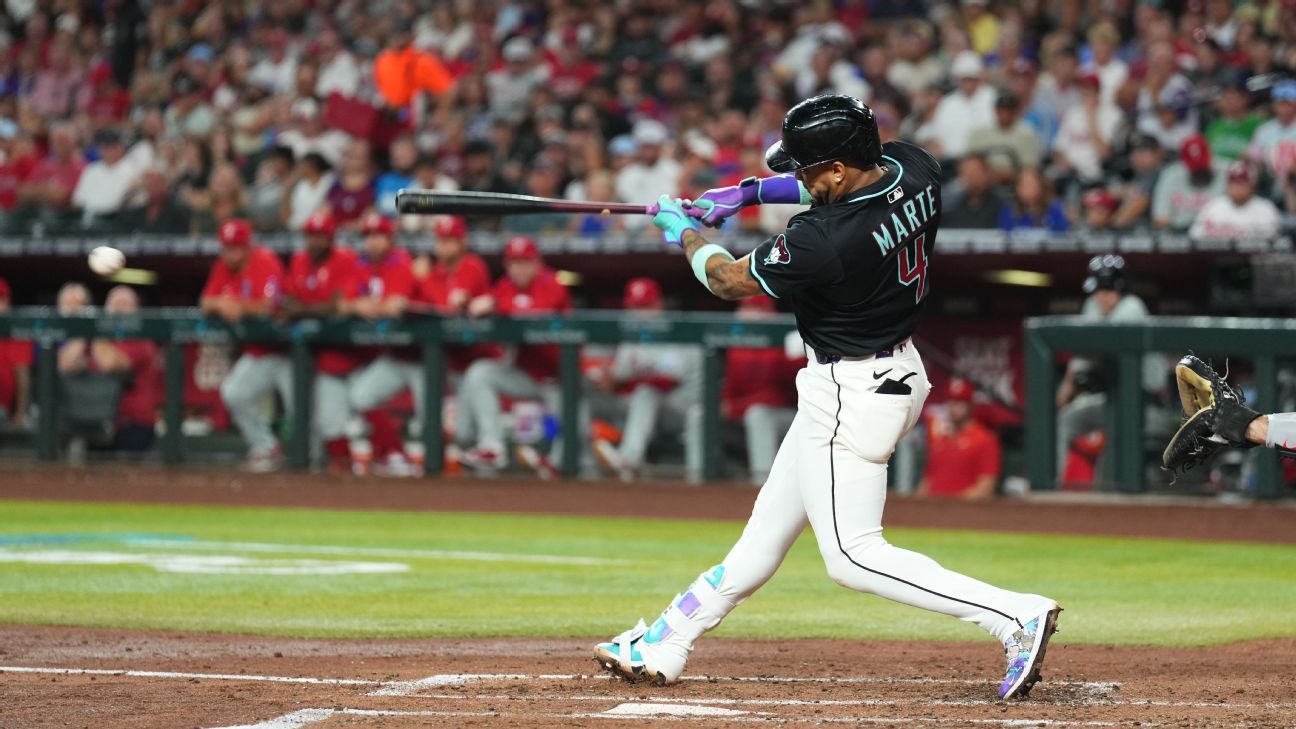
1. Ketel Marte, Arizona Diamondbacks
You can understand why Arizona maintained a high asking price on Marte before deciding not to trade him. Over the past three seasons, he has produced about 15 fWAR, or about $135 million in value, while making $40 million under the terms of his contract. Even in a season in which he invited scrutiny by going AWOL after the All-Star break following his home being robbed — a decision for which he eventually apologized to his team — he was still an incredibly effective player, with 28 homers, 87 runs and a 145 OPS+ in 126 games. He excels offensively, and while the numbers suggest he is just average defensively, he continues to be the preeminent player at this position.

2. Nico Hoerner, Chicago Cubs
He led all second basemen in fWAR last season, doing what he does best — excelling on defense and winning his second Gold Glove Award; scoring 89 runs in 156 games; and stealing bases at a high rate (29 in 35 attempts). Hoerner hit .297 and his strikeout rate was 7.6%, third lowest in the big leagues (behind Luis Arraez and Jacob Wilson).

3. Jazz Chisholm Jr., New York Yankees
Based on Chisholm’s production in WAR, ESPN analyst Paul Hembekides says he believes his contract value as a free agent could look like this — $80 million over two years, or $140 million over four years. But Chisholm probably needs to balance his home/road splits to draw heightened interest from teams other than the Yankees. These were his 2025 numbers:
In Yankee Stadium: .277/.364/.528, for a 150 wRC+
In all other parks: .207/.299/.432, for a 101 wRC+
Again: Consistency. Teams will pay for it.

4. Brice Turang, Milwaukee Brewers
He was one of MLB’s breakout stars last season, performing so well that he earned some down-ballot support in the National League MVP voting. Turang scored 97 runs in 156 games, with an OPS+ of 121, and he continues to improve in his power production — he had 28 doubles and 18 home runs to go with 24 stolen bases in 2025. That was all part of a larger design: Turang’s exit velocity jumped from 85.1 mph to 89.2 mph (with his strikeout rate also spiking). His defensive numbers dipped last year, with his defensive runs saved falling from a remarkable 22 in 2024 to seven last season.

5. Brendan Donovan, Seattle Mariners
He could play some third early in the season, or get some time in the outfield, but if the Mariners decide to play top prospect Cole Emerson on the left side of the infield, Donovan could get a lot of games at second. No matter where he lands, he’s going to get on base and he’s going to create opportunities for runs. He had a 119 OPS+, with 32 doubles and 10 homers in 119 games, and he appears to be a prime candidate to lead off for Seattle against right-handed pitching. Last year, Donovan hit .315 with a .383 OBP against right-handers.

6. Gleyber Torres, Detroit Tigers
That Torres accepting a one-year qualifying offer from Detroit is a strong indication that he knows he needs a strong offensive performance to set himself up for a multiyear contract (with the benefit of breaking away from draft pick compensation). As Torres has gained experience, he’s drawing more walks and getting on base at a higher rate — he accumulated 136 hits and a career-high 85 walks last season, while reducing his strikeout rate from 20.1% in ’24 to 16.1%.

7. Xavier Edwards, Miami Marlins
The shift from shortstop to second base seemed to really benefit him last season — he had 12 defensive runs saved and nine outs above average while playing only 96 games at second. The 26-year-old accumulated 159 hits and 49 walks in 139 games last season, for a .343 on-base percentage.

8. Marcus Semien, New York Mets
He’s still a high-end defender and now part of David Stearns’s effort to improve the Mets’ run prevention, even at age 35. But the Rangers made him available for a trade largely because of the decline in his offense the past two seasons:
2023: 126 OPS+
2024: 103 OPS+
2025: 97 OPS+

9. Bryson Stott, Philadelphia Phillies
If the Phillies had acquired Bo Bichette — and they thought they were going to get him — then Bichette probably would’ve played second base for Philadelphia, with Stott moving to third. Stott will hit for some power and steal some bases (24 last season), but his struggles against lefties were acute last year: a .225/.287/.575 slash line, with one homer in 123 plate appearances.

10. Ernie Clement, Toronto Blue Jays
He makes this list on the strength of how well he performed this past October. Facing the best pitching under the most pressure, Clement made contact, batting .411 over 18 games in the postseason. With Bichette’s departure and the shift of Andres Gimenez to shortstop, Clement takes over second, a spot where he excelled last year, with 10 defensive runs saved in only 423 innings.
Honorable mentions
Jose Altuve, Houston Astros: Houston is obviously well aware of his defensive issues at second base, which is why they tried him in left field. But Altuve can still do damage offensively — he hit 26 homers and had an adjusted OPS of 112.
Luis Arraez, San Francisco Giants: He wants to return to his former position, so he signed with the Giants, who are buying into his goal of becoming playable at second base — and into his ability to make contact.
Jackson Holliday, Baltimore Orioles: Still just 22 years old, he improved in his second year in the majors, hitting 17 homers and becoming more of a threat against left-handed pitching. But he’ll probably sit out the start of the season after suffering a hand (hamate bone) injury.
Brandon Lowe, Pittsburgh Pirates: Here’s the good stuff: 31 homers and a slugging percentage of .477 last season. The not-so-good stuff: minus-14 defensive runs saved and minus-13 outs above average.
Luke Keaschall, Minnesota Twins: You could make a reasonable case that he should already be in the top 10 after his strong showing in 49 games last year, when the former second-round pick hit .302 and generated 2.0 bWAR.
Ozzie Albies, Atlanta Braves: He remained largely injury-free last year, playing in 157 games, but he dipped to a .671 OPS and 89 OPS+. The Braves hold a $7 million club option for 2027.
Chase Meidroth, Chicago White Sox: One of the players acquired in the Garrett Crochet trade, Meidroth mustered 1.3 bWAR over 122 games in his rookie season of 2025.
Source link